medRxiv
  • Home
  • About
  • Submit
  • ALERTS / RSS
Advanced Search

Effects of transcranial direct current stimulation (tDCS) combined with cognitive therapy in individuals with cognitive impairment: a systematic review and meta-analysis

View ORCID ProfilePatricio Soto-Fernández, View ORCID ProfileLilian Toledo-Rodríguez, View ORCID ProfileAlejandra Figueroa-Vargas, View ORCID ProfilePaulo Figueroa-Taiba, View ORCID ProfilePablo Billeke
doi: https://doi.org/10.64898/2026.04.26.26351755
Patricio Soto-Fernández
1Laboratorio de Neurociencia Social y Neuromodulación, Centro de Investigación en Complejidad Social, Facultad de Gobierno, Universidad del Desarrollo, Santiago, Chile
  • Find this author on Google Scholar
  • Find this author on PubMed
  • Search for this author on this site
  • ORCID record for Patricio Soto-Fernández
  • For correspondence: flgo.patriciosoto{at}gmail.com pbilleke{at}udd.cl
Lilian Toledo-Rodríguez
2Departamento de Fonoaudiología, Facultad de Medicina, Universidad de Chile, Santiago, Chile
3Departamento de Neurología-Neurocirugía, Hospital Clínico Universidad de Chile, Santiago, Chile
  • Find this author on Google Scholar
  • Find this author on PubMed
  • Search for this author on this site
  • ORCID record for Lilian Toledo-Rodríguez
Alejandra Figueroa-Vargas
1Laboratorio de Neurociencia Social y Neuromodulación, Centro de Investigación en Complejidad Social, Facultad de Gobierno, Universidad del Desarrollo, Santiago, Chile
  • Find this author on Google Scholar
  • Find this author on PubMed
  • Search for this author on this site
  • ORCID record for Alejandra Figueroa-Vargas
Paulo Figueroa-Taiba
1Laboratorio de Neurociencia Social y Neuromodulación, Centro de Investigación en Complejidad Social, Facultad de Gobierno, Universidad del Desarrollo, Santiago, Chile
4Laboratorio de Biomecánica Clínica, Carrera de Kinesiología, Facultad de Medicina Clínica Alemana, Universidad del Desarrollo, Santiago, Chile
  • Find this author on Google Scholar
  • Find this author on PubMed
  • Search for this author on this site
  • ORCID record for Paulo Figueroa-Taiba
Pablo Billeke
1Laboratorio de Neurociencia Social y Neuromodulación, Centro de Investigación en Complejidad Social, Facultad de Gobierno, Universidad del Desarrollo, Santiago, Chile
  • Find this author on Google Scholar
  • Find this author on PubMed
  • Search for this author on this site
  • ORCID record for Pablo Billeke
  • For correspondence: flgo.patriciosoto{at}gmail.com pbilleke{at}udd.cl
  • Abstract
  • Full Text
  • Info/History
  • Metrics
  • Data/Code
  • Preview PDF
Loading

Abstract

Background Cognitive impairment poses a significant challenge to healthcare systems worldwide, impacting patient autonomy, social participation, and quality of life, while placing a considerable burden on caregivers. Non-pharmacological interventions, particularly cognitive training and non-invasive brain stimulation, have emerged as promising therapeutic strategies.

Objective This study aims to quantify the synergistic effects of transcranial direct current stimulation (tDCS) with cognitive training on cognitive function across a spectrum of pathologies that induce cognitive impairment.

Methods We conducted a systematic review and meta-analysis following PRISMA guidelines. We searched PubMed for randomized controlled trials that investigated the effect of combined tDCS and cognitive training compared with cognitive training alone. The analysis was based on the GRADE framework for systematic reviews and meta-analyses.

Results Across 27 studies including 1,012 participants, tDCS combined with cognitive training showed a small effect compared with cognitive training alone (SMD = 0.36, 95% CI: 0.15–0.56). The effect was found only immediately after the intervention and declined during follow-up.

Conclusion tDCS combined with cognitive training may provide a small, short-term benefit for cognitive function, but high heterogeneity across studies and loss of effect at follow-up underscore the need for larger, better-standardized trials to clarify its clinical value.

Highlights

  • - Combined tDCS and cognitive training produce a small but statistically significant short-term improvement in global cognitive performance.

  • - Effects attenuate over time, highlighting limited durability without sustained or maintenance interventions.

  • - High methodological heterogeneity and very low certainty of evidence limit broad clinical generalization.

Introduction

Population aging is one of the most significant demographic transitions of the twenty-first century. Improvements in healthcare and living conditions have substantially increased life expectancy worldwide, leading to a rapidly growing proportion of older adults in the global population. This demographic shift has been accompanied by a rising prevalence of chronic age-related conditions, including both neurodegenerative and acquired disorders associated with cognitive impairment (1–4). Cognitive deficits are a hallmark of several of these conditions, including mild cognitive impairment (MCI), Alzheimer’s disease, Parkinson’s disease, stroke, and other neurological disorders, affecting core cognitive domains such as memory, attention, and executive functions that are critical for independent functioning (5,6).

The consequences of cognitive impairment extend beyond cognitive symptoms themselves. As cognitive decline progresses, individuals frequently experience reductions in functional independence, including difficulties performing activities of daily living and maintaining social engagement (7–9). These limitations often result in significant decreases in quality of life. In addition, caregivers commonly experience substantial emotional, physical, and financial burden associated with providing long-term support to individuals with cognitive impairment (10,11). At a societal level, the growing prevalence of cognitive disorders represents a major challenge for healthcare systems and social security structures, generating considerable economic costs related to medical care, long-term assistance, and caregiver support services (12).

From a neurobiological perspective, cognitive disorders share disruptions in cortical excitability and synaptic plasticity mechanisms. In particular, alterations in local neural activity and long-term potentiation (LTP)-like processes have been identified as key mechanisms underlying deficits in attention, memory, and executive function (13,14). Abnormalities in cortical excitability and impaired cortical plasticity have been consistently documented in individuals with mild cognitive impairment and Alzheimer’s disease, suggesting a common neurophysiological substrate that may represent a viable therapeutic target (15,16).

Despite extensive research, currently available pharmacological and behavioral interventions often produce limited or inconsistent improvements in cognitive functioning, and many fail to generate clinically meaningful benefits. These limitations have motivated the search for alternative therapeutic approaches that directly modulate neural activity and promote neuroplasticity (17,18). In this context, non-invasive brain stimulation techniques have emerged as promising tools for cognitive rehabilitation (19).

Transcranial direct current stimulation (tDCS) has gained increasing attention due to its capacity to modulate cortical excitability by applying weak electrical currents through scalp electrodes (20). tDCS offers several practical advantages for clinical use, including relatively low cost, easy administration, and minimal adverse effects (21). Importantly, this technique enables targeted modulation of cortical regions involved in specific cognitive processes, allowing for more localized neuromodulatory effects while potentially reducing systemic side effects commonly associated with pharmacological treatments, which may also present contraindications in certain patient populations (22–24). In parallel with advances in the understanding of the neurobiological mechanisms underlying cognition and brain plasticity, the number of clinical trials investigating tDCS as a therapeutic intervention for cognitive impairment has grown substantially over the past decade.

However, findings across studies remain heterogeneous and sometimes inconsistent (25). One important factor contributing to this variability is the diversity of stimulation protocols currently used, including differences in electrode montage, stimulation intensity, session duration, number of sessions, and concurrent cognitive interventions. This methodological heterogeneity complicates the identification of optimal stimulation parameters and limits the translation of research findings into standardized clinical protocols (26,27).

More recently, research has increasingly emphasized the importance of developing individualized neuromodulation approaches that account for participant-specific characteristics, including baseline cognitive performance, neurophysiological markers, and disease-specific mechanisms (28). A key element of this personalization is the timing and context of stimulation delivery, as the effects of neuromodulation depend on the state and activity of the targeted neural networks. In particular, for cognitive processes, stimulation may be more effective when administered concurrently with the relevant cognitive task. Within this framework, combining tDCS with cognitive training or cognitive therapy has been proposed as a promising strategy to enhance neuroplasticity by engaging task-relevant neural networks during stimulation (29–31).

Nevertheless, although an increasing number of clinical trials have investigated the combined use of tDCS and cognitive interventions in individuals with cognitive impairment, the magnitude and consistency of their effects remain unclear (32). Previous studies have reported mixed results, potentially due to differences in study design, stimulation parameters, patient populations, and outcome measures (33–35). A comprehensive synthesis of the current evidence is therefore needed to understand the effectiveness of these combined interventions better and to identify stimulation protocols that may yield the most robust cognitive benefits.

Therefore, the present systematic review and meta-analysis aim to evaluate the available evidence on the effects of tDCS combined with cognitive therapy on cognitive outcomes in individuals with cognitive impairment, and to identify stimulation parameters and intervention characteristics that may be associated with greater therapeutic efficacy.

Methods

Search and study selection

To determine the effect of adding tDCS to conventional therapy in individuals with cognitive impairment, we developed a systematic review and meta-analysis. The search strategy (Table S1) was structured around PICO parameters (36) and conducted using the MEDLINE database aligned with the Cochrane Library’s guidance on systematic review methodology (37). No date restrictions were applied in the search, allowing the inclusion of all relevant studies regardless of publication year. The results were screened and presented following the PRISMA diagram. Article selection and extraction were carried out by five independent researchers using the COVIDENCE platform. The inclusion and exclusion criteria are detailed in Table 1. Data extraction from the selected articles was then performed in an Excel spreadsheet for subsequent analysis.

View this table:
  • View inline
  • View popup
  • Download powerpoint
Table S1. Search strategy for tDCS effect on cognitive impairment.
View this table:
  • View inline
  • View popup
Table S2. Summary of findings for functional performance.
View this table:
  • View inline
  • View popup
  • Download powerpoint
Table 1. Inclusion and exclusion criteria based on PICO question.

Data Analysis

The extracted data were analyzed qualitatively and quantitatively. For the qualitative analysis, we focused on describing the characteristics of the populations included in the different studies, the stimulation protocols applied, and the specific brain regions targeted by the interventions. In contrast, the quantitative analysis examined outcomes related to improvements in cognitive performance, adverse events, and functional enhancements. These outcomes were synthesized through a summary of findings using GRADE methodology (38).

The quantitative analysis (meta-analysis) was performed using RevMan software, focusing on the different outcomes. For dichotomous outcomes, relative risk was calculated using the Mantel-Haenszel statistical method and a random-effects model. The results were then transformed into absolute values and summarized in the findings table. For continuous outcomes, the mean difference and standardized mean difference were calculated using the inverse-variance method within a random-effects model. The effect size was analyzed using the minimal important difference for the mean difference and Cohen’s coefficient for the standardized mean difference (SMD).

For each outcome, the effect size was calculated considering the six thresholds proposed in the gradebook (38). For outcomes expressed as relative effects, the thresholds were derived from health utility values. For outcomes measured with continuous scales and analyzed using mean differences, the thresholds were based on the minimal important difference. For outcomes analyzed using SMD, Cohen’s coefficient was used to establish the effect estimation thresholds.

Risk of bias

The risk of bias was assessed using the Cochrane ROB-2 tool (39). Only studies selected for the quantitative analysis were evaluated. Two investigators independently reviewed each article, and in cases of disagreement, a third investigator was involved to resolve the differences.

Quality of Evidence - GRADE

The certainty of the evidence was evaluated using the GRADE framework. The assessment considered the parameters of risk of bias, indirectness, inconsistency, and imprecision. This process followed the GRADE methodology (38), and the information for each outcome is summarized in the footnote of the Summary of Findings table.

Results

The search was conducted in January 2025 and repeated in June 2025 to update the data. We identified 601 articles. After screening by title, abstract, and full text, a total of 68 articles were selected, of which 27 were selected for data extraction and quantitative analysis (see Figure 1). Among the selected studies for analysis, 8 studies were analyzed for MCI post stroke (30,31,40–45), 4 articles for Alzheimer’s dementia (46–49), 2 for cognitive impairment secondary to HIV (50,51), 1 for Multiple Sclerosis (52), 2 for primary progressive aphasia (PPA) (53,54), and 10 for MCI (55–64).

Figure 1.
  • Download figure
  • Open in new tab
Figure 1.

PRISMA flow diagram of literature search and study selection.

Risk of bias was assessed using the ROB-2 tool. Across the included studies, the most prominent potential bias arose from insufficient reporting of whether outcome adjudicators—specifically those conducting post-intervention assessments—were blinded to group allocation. In contrast, the remaining domains of bias were generally judged to be low risk. These patterns are summarized in Figure 2.

Figure 2.
  • Download figure
  • Open in new tab
Figure 2.

Risk of bias

Across the included studies, participant age ranged from 22 to 95 years; only the multiple sclerosis study selected individuals younger than 50, while all other samples consisted exclusively of adults over 50. Cognitive outcomes were assessed using instruments such as the Mini-Mental State Examination (MMSE), Montreal Cognitive Assessment (MoCA), Wechsler Adult Intelligence Scale (WAIS), Alzheimer’s Disease Assessment Scale – Cognitive Subscale (ADAS-Cog), California Verbal Learning Test (CVLT), and Paced Auditory Serial Addition Test (PASAT). For functional status or independence, the studies employed instruments such as the Activities of Daily Living (ADL) scale, the Instrumental Activities of Daily Living (IADL) scale, the Barthel Index, and the Functional Independence Measure (FIM), depending on the population and study design. Finally, not all articles reported adverse events; only 15 (30,31,40–45,50,52,55–58,64) studies reported data on this aspect. All this information is summarized in Table 2.

View this table:
  • View inline
  • View popup
Table 2. General characteristics of studies included in the analysis.

The stimulation parameters are described in Table 3. All included studies employed an anodal tDCS configuration, targeting the left dorsolateral prefrontal cortex (DLPFC), specifically positioned over F3 according to the International 10–20 EEG system. The stimulation intensity ranged from 1.0 to 2.0 mA, with 2.0 mA being the most frequently used parameter across protocols. Session duration ranged from 20 to 60 minutes (the most frequent was 20 minutes), and interventions were delivered at a median frequency of 3 sessions per week, over a median total intervention period of 4 weeks.

View this table:
  • View inline
  • View popup
Table 3. Stimulation parameters described in studies.

Global Cognitive Performance

The long-term outcomes, stratified by the underlying etiology of cognitive deterioration, are presented in Table 4. Given the heterogeneity of measurement instruments across studies, the SMD was used to establish the effect size. Interpretation of the results followed Cohen’s conventional thresholds, considering an SMD of 0.2 or greater as indicative of a clinically meaningful effect.

View this table:
  • View inline
  • View popup
Table 4. Summary of findings for global cognitive performance.

The overall pooled effect corresponded to a clinically meaningful improvement, with an SMD of 0.36 (95% CI: 0.15 to 0.56; Z=3.44; p=0.0006). The analysis showed I² = 55% (heterogeneity) and a subgroup comparison p-value of 0.28, indicating no statistical support for differences between subgroups. These subgroup-level distinctions can be further appreciated in the individual results stratified by the underlying cause of cognitive deterioration.

The largest effect was observed in the context of PPA rehabilitation, with an SMD of 0.82 (95% CI: 0.20 to 1.44; Z=2.61; p=0.009). This was followed by cognitive impairment secondary to stroke, showing an SMD of 0.65 (95% CI: −0.02 to 1.32; Z=1.91; p=0.06), and by HIV-associated cognitive impairment, with an SMD of 0.43 (95% CI: −0.77 to 1.64; Z=0.70; p=0.48). In contrast, mild cognitive impairment and multiple sclerosis did not demonstrate meaningful effects, with SMDs of 0.15 (95% CI: −0.03 to 0.34; Z=1.68; p=0.09) and 0.07 (95% CI: −0.55 to 0.69; Z=0.23; p=0.82), respectively.

Despite the favorable findings, the overall certainty of the evidence remains very low for the global outcome. This is primarily driven by the wide confidence intervals surrounding the point estimate, which indicate substantial imprecision and limit the robustness of the observed effect. The detailed GRADE certainty assessment for this outcome is presented in the Summary of Findings table (Table 4 and Figure S1).
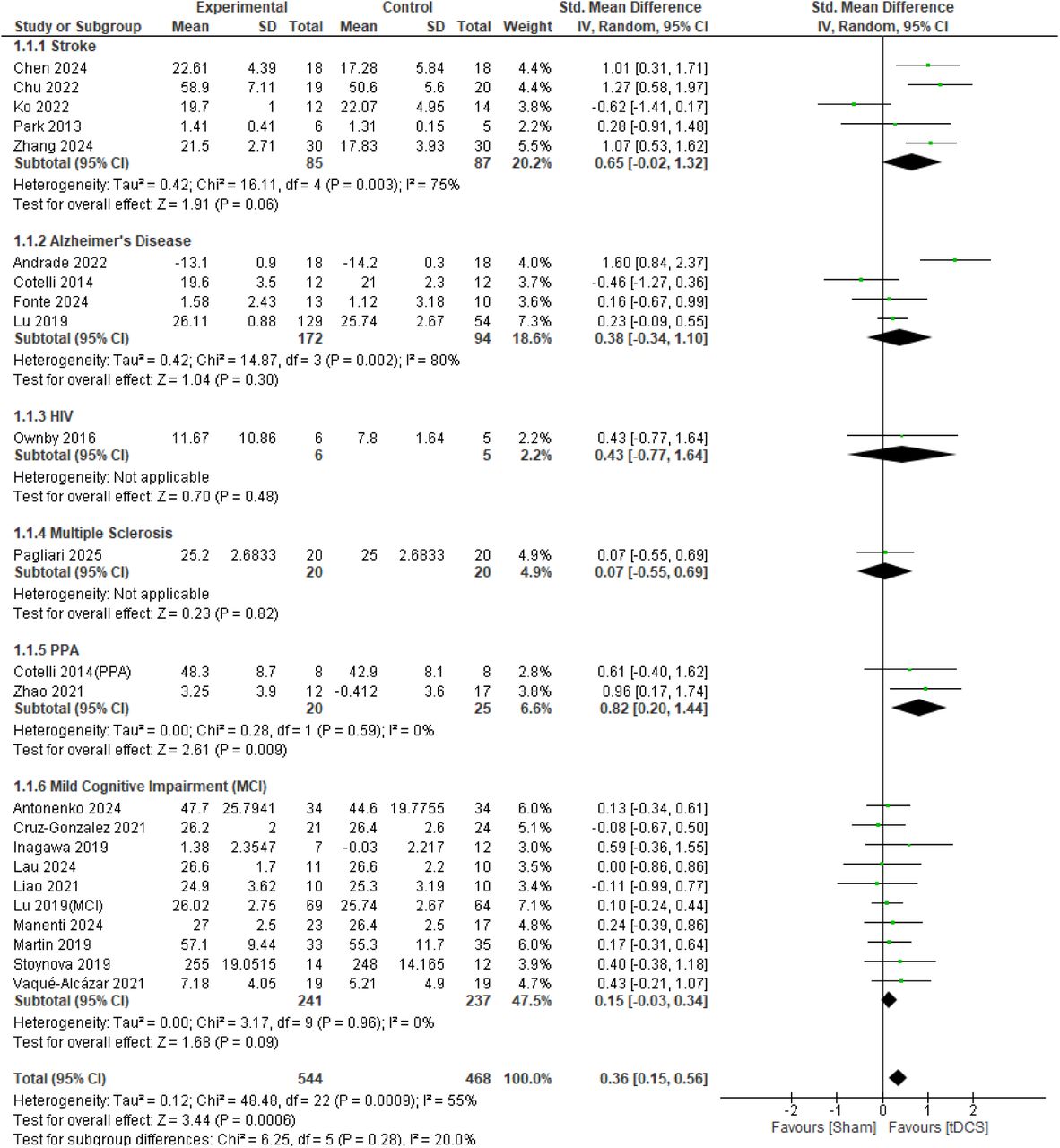
Figure S1.
  • Download figure
  • Open in new tab
Figure S1.

Forest plot for cognitive performance.

In the domain of functional performance in activities of daily living, the overall pooled effect was clinically meaningful (SMD 0.41, CI95% -0.09 - 0.91; Z=1.61; p=0.11). However, substantial inconsistency is evident in the forest plot (see Figure S2). Studies conducted in Alzheimer’s disease, mild cognitive impairment, and primary progressive aphasia don’t demonstrate effects in the use of tDCS (SMD -0.25, -0.33, and 0.02). In contrast, a clear and favorable effect was observed exclusively in cases of post-stroke cognitive impairment (SMD 0.97 - CI95% 0.34 - 1.59). This pattern of results is likely attributable to heterogeneity (I2=73%) and is supported by statistical evidence of subgroup differences, suggesting that the functional benefits of tDCS may be condition-specific rather than consistent across etiologies.

Figure S2.
  • Download figure
  • Open in new tab
Figure S2.

Forest plot for functional performance in activities of daily living.

Finally, the effect was examined across different follow-up periods, as illustrated in Figure 3. The results show that the magnitude of the global effect on cognitive performance progressively diminishes over time. In addition, the confidence intervals exhibit noticeable variation in their width, further reflecting the temporal instability of the estimated effect. This variability may be partly explained by the limited number of studies reporting follow-up beyond the post-intervention period, progressive attrition leading to smaller sample sizes over time (see Figure S3), the inherent heterogeneity of the underlying condition, or the instability of the intervention effect itself.

Figure S3.
  • Download figure
  • Open in new tab
Figure S3.

Effect of tDCS in cognitive performance in different follow-up.
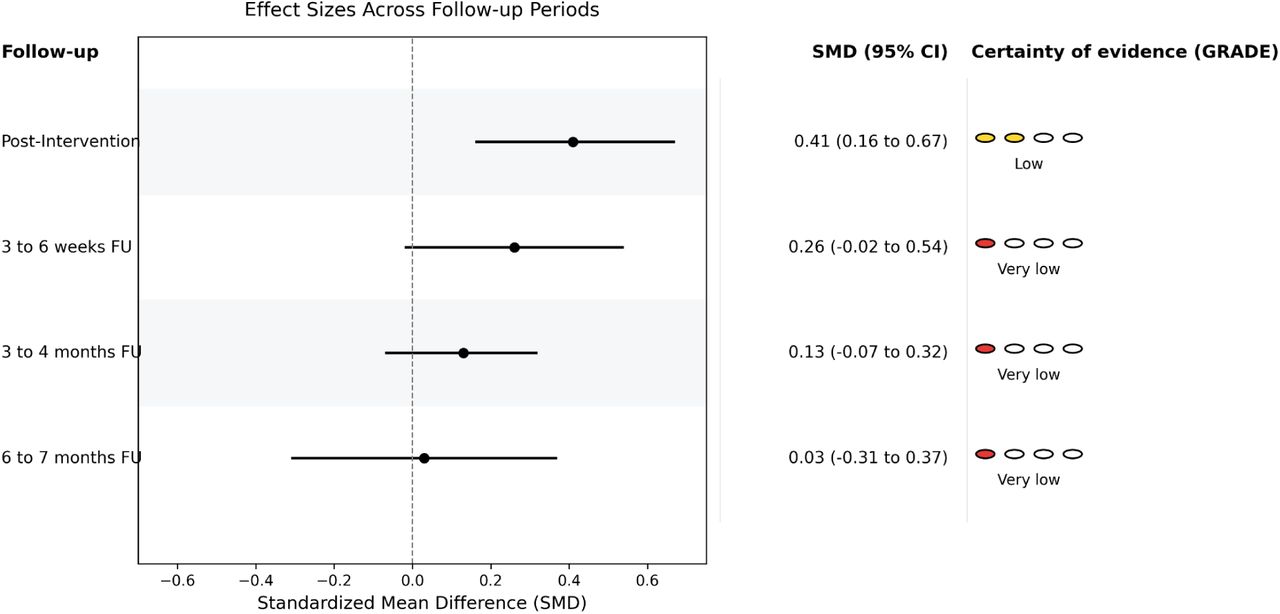
Figure 3.
  • Download figure
  • Open in new tab
Figure 3.

Estimated effect in different follow-ups.

Effect sizes (standardized mean differences, SMD) across follow-up periods. Pooled estimates with 95% confidence intervals are shown for post-intervention (N = 999), 3 to 6 weeks follow-up (N = 365), 3 to 4 months follow-up (N = 433), and 6 to 7 months follow-up (N = 135). Certainty of evidence was assessed using the GRADE framework and is indicated for each time point.

In summary, combined anodal tDCS and cognitive therapy is associated with a small-to-moderate improvement in overall global cognitive performance. Functional improvements in activities of daily living appear condition-dependent, emerging primarily in post-stroke populations. However, the overall certainty of the evidence is very low, constrained by imprecision, heterogeneity, and risk-of-bias concerns, and the observed benefits attenuate over time.

Discussion

The present systematic review and meta-analysis aimed to evaluate the effects of combining tDCS with cognitive training on cognitive outcomes in individuals with cognitive impairments across different etiologies. Our principal finding indicates that the combination yields a modest but statistically significant and likely clinically meaningful short-term improvement in global cognitive performance, although with substantial heterogeneity and low certainty of the evidence. Although this finding supports a potential adjunctive role for tDCS in cognitive rehabilitation, its interpretation should be tempered by the substantial heterogeneity observed across studies and the very low certainty of the evidence.

From a clinical perspective, these findings suggest that combined tDCS and cognitive therapy may be a useful adjunctive approach for cognitive rehabilitation, particularly in selected patient groups and when the stimulation is applied in close association with the cognitive task. The modest overall effect observed in our meta-analysis is consistent with previous work showing small but positive benefits of tDCS-based interventions on cognition, especially when stimulation parameters and behavioral training are well aligned (65,66). Importantly, prior studies have also suggested that the clinical impact of tDCS may depend on baseline cognitive resources, the target domain, and the specific neurological condition being treated, with some populations—such as stroke survivors—appearing more responsive than others (67,68). At the same time, the high heterogeneity across studies indicates that these benefits cannot yet be generalized to all patients or protocols, and that more standardized and etiologically stratified trials are needed to determine which individuals are most likely to benefit (69,70).

Several features of the included interventions may help explain the pattern of results. Considerable methodological heterogeneity (targets, intensities, session dosing, and cognitive task paradigms) and outcome heterogeneity (diverse neuropsychological instruments) contributed to between-study variability and limited the precision of pooled estimates (69). The subgroup signal favoring primary progressive aphasia and post-stroke conditions may reflect a better alignment between stimulation targets and the dysfunctional networks that are co-activated by language or domain-specific cognitive therapy. By contrast, mild cognitive impairment and multiple sclerosis trials—often characterized by broader cognitive phenotypes and variable disease mechanisms—did not show consistent benefits, which could also be due to smaller samples, different cognitive endpoints, or protocol mismatches.

The attenuation of effects over time raises questions about durability and the potential role of maintenance sessions or longer treatment courses to sustain gains. The rapid attenuation of effects observed at follow-up also highlights a critical limitation in current intervention designs: insufficient dosing and lack of maintenance protocols. The neuroplastic changes induced by tDCS and cognitive training may require sustained or repeated reinforcement to consolidate into long-term functional improvements (71,72). Future studies should systematically investigate dose-response relationships, including session frequency, total duration, and the potential role of booster sessions, to determine whether more durable cognitive gains can be achieved.

Given the very low certainty for the global cognitive outcome, routine adoption of combined tDCS and cognitive therapy cannot be broadly endorsed at this time. If considered, the application may be most justifiable in post-stroke cognitive impairment or primary progressive aphasia, ideally within research or quality-assurance frameworks, with careful target selection, standardized cognitive protocols, and systematic monitoring of outcomes and adverse events. Remote-supervised models may enhance access and adherence, but standardized safety reporting remains.

Personalization may be a key determinant of the clinical efficacy of non-invasive brain stimulation (28,73). In particular, targeting stimulation according to individual neurobiological profiles, including residual network activity and lesion-specific circuitry, may help optimize the effects of non-invasive brain stimulation. This is especially relevant in conditions such as post-stroke cognitive impairment, where preserved but functionally impaired networks may be more amenable to modulation. A key aspect relevant to tDCS personalization, and more broadly to non-invasive brain stimulation techniques, is the need for a precise alignment with specific clinical and cognitive therapeutic goals. Cognitive impairment does not present uniformly; rather, it manifests as distinct profiles across patients and pathologies (74–76). These profiles reflect individual patterns of brain network organization, function, and dynamics, underscoring the importance of tailoring interventions to each patient’s neurocognitive characteristics (77,78). Recent evidence suggests that specific cognitive processes, at the computational level, can be modulated, thereby improving the neural activity associated with them (79–81). For example, strong evidence across different pathologies has shown that specific signatures of electrical activity can be identified during working memory tasks (82–85). These features are crucial for enhancing the specificity of non-invasive brain stimulation during cognitive training, particularly when the intervention is tailored to the specific cognitive process (86). In this context, studies involving larger clinical samples, together with more precise physiological investigations, are urgently needed to strengthen the evidence base and to clarify how key brain functions and dynamics are associated with specific symptom profiles, thereby providing a stronger rationale for evaluating non-invasive brain stimulation therapies targeted to relevant clinical features.

A clear example of a neglected aspect in studies of cerebral functioning is the cerebellum. Emerging evidence suggests that cerebellar involvement should not be overlooked, given its role in cognitive and affective processing and its connections with frontoparietal control networks (71,72). In this context, biomarkers derived from functional MRI and EEG may provide valuable information to identify patients most likely to benefit from treatment by capturing baseline network integrity, task-related activation, and neurophysiological responsiveness. Such biomarker-guided approaches could move the field beyond a one-size-fits-all model toward more precise and mechanistically informed intervention strategies.

An additional critical factor that may account for variability in tDCS effects is state-dependency (28). The impact of stimulation is not only determined by anatomical targeting but also by the neural circuits’ ongoing activity at the time of stimulation. In this sense, the same stimulation protocol may produce different or even opposite effects depending on the baseline excitability and functional engagement of the targeted network (87). This principle reinforces the importance of delivering stimulation in conjunction with task-relevant cognitive engagement, as well as the potential value of monitoring neural states in real time to optimize intervention timing (88,89).

Importantly, translating these findings into real-world clinical settings requires careful consideration of feasibility, adherence, and scalability (90). While tDCS offers practical advantages, including low cost and ease of administration, implementing individualized, biomarker-informed protocols may pose logistical challenges that require advances in portable technologies and remote monitoring systems. Moreover, the transfer of cognitive improvements to functional gains in activities of daily living remains highly uncertain, due to the current lack of robust evidence supporting functional outcomes.

In conclusion, the present findings indicate that combining tDCS with cognitive training yields modest, short-lived improvements in cognitive performance, with effects highly dependent on clinical context, intervention design, and underlying neurobiological variability. Rather than reflecting a uniformly effective therapeutic approach, the current evidence suggests that the efficacy of combined neuromodulation strategies depends on alignment among stimulation parameters, targeted cognitive processes, and the integrity of the underlying neural networks. Moving forward, progress in this field will depend on integrating mechanistically informed, individualized intervention frameworks, supported by physiological biomarkers and computational models that capture the dynamic interplay between brain stimulation and cognitive function. Such approaches may enable a transition from heterogeneous, protocol-driven applications to precision neurorehabilitation strategies with greater clinical impact and durability.

Data Availability

All data produced in the present work are contained in the manuscript

Acknowledgements

This work was supported by Grants 1251073 (PB), 11261678 (AF-V) from the Fondo Nacional de Ciencia y Tecnología (FONDECYT) from Agencia Nacional de Investigación y Desarrollo (ANID). The funders had no role in study design, data collection, and analysis, the decision to publish, or the preparation of the manuscript.

References

  1. 1.↵
    Cunningham LJ, Stapleton T, Walsh K, Horgan F. Post-stroke cognitive impairment is associated with poorer return-to-work outcomes in working-aged stroke survivors: A systematic review. Clin Rehabil. 10 de febrero de 2026;02692155261420770. doi:10.1177/02692155261420770
    OpenUrlCrossRef
  2. 2.
    Kelebie M, Kibralew G, Tadesse G, Nakie G, Muche M, Ali D, et al. The role of HAART in mitigating neurocognitive decline among HIV-positive Africans: Systematic review and meta-analysis. Compr Psychiatry. noviembre de 2025;143:152639. doi:10.1016/j.comppsych.2025.152639
    OpenUrlCrossRef
  3. 3.
    Livingston G, Huntley J, Liu KY, Costafreda SG, Selbæk G, Alladi S, et al. Dementia prevention, intervention, and care: 2024 report of the Lancet standing Commission. The Lancet. agosto de 2024;404(10452):572-628. doi:10.1016/S0140-6736(24)01296-0
    OpenUrlCrossRefPubMed
  4. 4.↵
    Prince M, Wimo A, Guerchet M, Ali GemmaC, Wu YT, Prina M. World Alzheimer Report 2024: An Analysis of Prevalence, Incidence, Cost and Trends [Internet]. London; 2015. Disponible en: https://www.alzint.org/u/WorldAlzheimerReport2015.pdf
  5. 5.↵
    Gauthier S, Reisberg B, Zaudig M, Petersen RC, Ritchie K, Broich K, et al. Mild cognitive impairment. The Lancet. abril de 2006;367(9518):1262-70. doi:10.1016/S0140-6736(06)68542-5
    OpenUrlCrossRefPubMedWeb of Science
  6. 6.↵
    Petersen RC. Mild Cognitive Impairment. N Engl J Med. 9 de junio de 2011;364(23):2227-34. doi:10.1056/NEJMcp0910237
    OpenUrlCrossRefPubMedWeb of Science
  7. 7.↵
    Tomaszewski Farias S, Cahn-Weiner DA, Harvey DJ, Reed BR, Mungas D, Kramer JH, et al. Longitudinal Changes in Memory and Executive Functioning are Associated with longitudinal change in instrumental activities of daily living in older Adults. Clin Neuropsychol. abril de 2009;23(3):446–61. doi:10.1080/13854040802360558
    OpenUrlCrossRefPubMedWeb of Science
  8. 8.
    Jefferson AL, Cahn-Weiner D, Boyle P, Paul RH, Moser DJ, Gordon N, et al. Cognitive predictors of functional decline in vascular dementia. Int J Geriatr Psychiatry. agosto de 2006;21(8):752–4. doi:10.1002/gps.1556
    OpenUrlCrossRefPubMedWeb of Science
  9. 9.↵
    Cahn-Weiner DA, Farias ST, Julian L, Harvey DJ, Kramer JH, Reed BR, et al. Cognitive and neuroimaging predictors of instrumental activities of daily living. J Int Neuropsychol Soc. septiembre de 2007;13(5):747–57. doi:10.1017/S1355617707070853
    OpenUrlCrossRefPubMedWeb of Science
  10. 10.↵
    Adelman RD, Tmanova LL, Delgado D, Dion S, Lachs MS. Caregiver Burden: A Clinical Review. JAMA. 12 de marzo de 2014;311(10):1052. doi:10.1001/jama.2014.304
    OpenUrlCrossRefPubMedWeb of Science
  11. 11.↵
    World Health Organization. Ageing and health [Internet]. 1 de octubre de 2025 [citado 23 de marzo de 2026]. Disponible en: https://www.who.int/news-room/fact-sheets/detail/ageing-and-health
  12. 12.↵
    Livingston G, Huntley J, Liu KY, Costafreda SG, Selbæk G, Alladi S, et al. Dementia prevention, intervention, and care: 2024 report of the Lancet standing Commission. The Lancet. agosto de 2024;404(10452):572-628. doi:10.1016/S0140-6736(24)01296-0
    OpenUrlCrossRefPubMed
  13. 13.↵
    Stagg CJ, Nitsche MA. Physiological Basis of Transcranial Direct Current Stimulation. The Neuroscientist. febrero de 2011;17(1):37–53. doi:10.1177/1073858410386614
    OpenUrlCrossRefPubMedWeb of Science
  14. 14.↵
    Nitsche MA, Fricke K, Henschke U, Schlitterlau A, Liebetanz D, Lang N, et al. Pharmacological modulation of cortical excitability shifts induced by transcranial direct current stimulation in humans. J Physiol. 15 de noviembre de 2003;553(Pt 1):293-301. doi:10.1113/jphysiol.2003.049916 PubMed PMID: 12949224; PubMed Central PMCID: PMC2343495.
    OpenUrlCrossRefPubMedWeb of Science
  15. 15.↵
    Dognini E, Finazzi S, Campana E, Manenti R, Cotelli M, Borroni B. Transcranial Magnetic Stimulation as a Diagnostic Tool in Mild Cognitive Impairment: A Systematic Review. Brain Sci. 9 de septiembre de 2025;15(9):969. doi:10.3390/brainsci15090969
    OpenUrlCrossRef
  16. 16.↵
    Chou Y hui, Sundman M, Ton That V, Green J, Trapani C. Cortical excitability and plasticity in Alzheimer’s disease and mild cognitive impairment: A systematic review and meta-analysis of transcranial magnetic stimulation studies. Ageing Res Rev. agosto de 2022;79:101660. doi:10.1016/j.arr.2022.101660
    OpenUrlCrossRef
  17. 17.↵
    Alzheimer’s Disease International. World Alzheimer Report 2025: Reimagining life with dementia – the power of rehabilitation [Internet]. London; 2025. Disponible en: https://www.alzint.org/u/World-Alzheimer-Report-2025.pdf
  18. 18.↵
    Polanía R, Nitsche MA, Ruff CC. Studying and modifying brain function with non-invasive brain stimulation. Nat Neurosci. febrero de 2018;21(2):174–87. doi:10.1038/s41593-017-0054-4
    OpenUrlCrossRefPubMed
  19. 19.↵
    Wu M, Song W, Wang X, Teng L, Li J, Zhang J, et al. Efficacy of non-invasive brain stimulation interventions on cognitive impairment: an umbrella review of meta-analyses of randomized controlled trials. J NeuroEngineering Rehabil. 5 de febrero de 2025;22(1):22. doi:10.1186/s12984-025-01566-3
    OpenUrlCrossRef
  20. 20.↵
    Reed T, Cohen Kadosh R. Transcranial electrical stimulation (tES) mechanisms and its effects on cortical excitability and connectivity. J Inherit Metab Dis. diciembre de 2018;41(6):1123–30. doi:10.1007/s10545-018-0181-4
    OpenUrlCrossRefPubMed
  21. 21.↵
    Carther-Krone T, Ko JH. A review on the reporting and assessment of adverse effects associated with high-definition transcranial direct current stimulation. Front Hum Neurosci. 5 de diciembre de 2025;19:1682771. doi:10.3389/fnhum.2025.1682771
    OpenUrlCrossRef
  22. 22.↵
    Stagg CJ, Antal A, Nitsche MA. Physiology of Transcranial Direct Current Stimulation. J ECT. septiembre de 2018;34(3):144–52. doi:10.1097/YCT.0000000000000510
    OpenUrlCrossRefPubMed
  23. 23.
    Pini L, Allali G, Imbimbo BP, Germani M, Corbetta M. Brain connectivity as a new target for Alzheimer’s disease therapy? Brain. 7 de febrero de 2026;149(2):432-8. doi:10.1093/brain/awaf404
    OpenUrlCrossRef
  24. 24.↵
    Brunoni AR, Nitsche MA, Bolognini N, Bikson M, Wagner T, Merabet L, et al. Clinical research with transcranial direct current stimulation (tDCS): Challenges and future directions. Brain Stimulat. julio de 2012;5(3):175–95. doi:10.1016/j.brs.2011.03.002
    OpenUrlCrossRefPubMed
  25. 25.↵
    Pini L, Manenti R, Cotelli M, Pizzini FB, Frisoni GB, Pievani M. Non-Invasive Brain Stimulation in Dementia: A Complex Network Story. Neurodegener Dis. 2018;18(5-6):281–301. doi:10.1159/000495945
    OpenUrlCrossRefPubMed
  26. 26.↵
    Soleimani G, Alekseichuk I, Aurup C, Bergmann TO, Bestmann S, Beynel L, et al. Dose-response relationships in transcranial brain stimulation: Physics, physiology and mechanism. Brain Stimulat. mayo de 2026;19(3):103067. doi:10.1016/j.brs.2026.103067
    OpenUrlCrossRef
  27. 27.↵
    Polanía R, Nitsche MA, Korman C, Batsikadze G, Paulus W. The Importance of Timing in Segregated Theta Phase-Coupling for Cognitive Performance. Curr Biol. julio de 2012;22(14):1314–8. doi:10.1016/j.cub.2012.05.021
    OpenUrlCrossRefPubMed
  28. 28.↵
    Soleimani G, Nitsche MA, Hanlon CA, Lim KO, Opitz A, Ekhtiari H. Four dimensions of individualization in brain stimulation for psychiatric disorders: context, target, dose, and timing. Neuropsychopharmacology. mayo de 2025;50(6):857–70. doi:10.1038/s41386-025-02094-3
    OpenUrlCrossRefPubMed
  29. 29.↵
    Zhang L, Zhou L, Ye Q, Zhang L, Kong Y, Xia S. Impact of transcranial direct current stimulation combined with motor-cognitive intervention on post-stroke cognitive impairment. Neurol Sci. abril de 2024;45(4):1581–8. doi:10.1007/s10072-023-07156-2
    OpenUrlCrossRefPubMed
  30. 30.↵
    Ko MH, Yoon JY, Jo YJ, Son MN, Kim DS, Kim GW, et al. Home-Based Transcranial Direct Current Stimulation to Enhance Cognition in Stroke: Randomized Controlled Trial. Stroke. octubre de 2022;53(10):2992–3001. doi:10.1161/strokeaha.121.037629
    OpenUrlCrossRefPubMed
  31. 31.↵
    Park SH, Koh EJ, Choi HY, Ko MH. A Double-Blind, Sham-Controlled, Pilot Study to Assess the Effects of the Concomitant Use of Transcranial Direct Current Stimulation with the Computer Assisted Cognitive Rehabilitation to the Prefrontal Cortex on Cognitive Functions in Patients with Stroke. J Korean Neurosurg Soc. 2013;54(6):484. doi:10.3340/jkns.2013.54.6.484
    OpenUrlCrossRefPubMed
  32. 32.↵
    Schrammen E, Roesmann K, Rosenbaum D, Redlich R, Harenbrock J, Dannlowski U, et al. Functional neural changes associated with psychotherapy in anxiety disorders – A meta-analysis of longitudinal fMRI studies. Neurosci Biobehav Rev. noviembre de 2022;142:104895. doi:10.1016/j.neubiorev.2022.104895
    OpenUrlCrossRef
  33. 33.↵
    Burton CZ, Garnett EO, Capellari E, Chang SE, Tso IF, Hampstead BM, et al. Combined Cognitive Training and Transcranial Direct Current Stimulation in Neuropsychiatric Disorders: A Systematic Review and Meta-analysis. Biol Psychiatry Cogn Neurosci Neuroimaging. febrero de 2023;8(2):151–61. doi:10.1016/j.bpsc.2022.09.014
    OpenUrlCrossRefPubMed
  34. 34.
    Indahlastari A, Hardcastle C, Albizu A, Alvarez-Alvarado S, Boutzoukas EM, Evangelista ND, et al. A Systematic Review and Meta-Analysis of Transcranial Direct Current Stimulation to Remediate Age-Related Cognitive Decline in Healthy Older Adults. Neuropsychiatr Dis Treat. 2021;17:971–90. doi:10.2147/NDT.S259499 PubMed PMID: 33824591; PubMed Central PMCID: PMC8018377.
    OpenUrlCrossRefPubMed
  35. 35.↵
    Lv Y, Wu S, Nitsche MA, Yue T, Zschorlich VR, Qi F. A meta-analysis of the effects of transcranial direct current stimulation combined with cognitive training on working memory in healthy older adults. Front Aging Neurosci. 23 de septiembre de 2024;16:1454755. doi:10.3389/fnagi.2024.1454755
    OpenUrlCrossRefPubMed
  36. 36.↵
    Guyatt GH, Oxman AD, Kunz R, Atkins D, Brozek J, Vist G, et al. GRADE guidelines: 2. Framing the question and deciding on important outcomes. J Clin Epidemiol. abril de 2011;64(4):395–400. doi:10.1016/j.jclinepi.2010.09.012
    OpenUrlCrossRefPubMed
  37. 37.↵
    Lefebvre C, Glanville J, Briscoe S, Littlewood A, Marshall C, Metzendorf M, et al. Searching for and selecting studies. En: Higgins JPT, Thomas J, Chandler J, Cumpston M, Li T, Page MJ, et al., editores. Cochrane Handbook for Systematic Reviews of Interventions [Internet]. 1.a ed. Wiley; 2019 [citado 27 de febrero de 2026]. p. 67-107. Disponible en: https://onlinelibrary.wiley.com/doi/10.1002/9781119536604.ch4 doi:10.1002/9781119536604.ch4
    OpenUrlCrossRef
  38. 38.↵
    GRADE Book [Internet]. [citado 27 de febrero de 2026]. Disponible en: https://book.gradepro.org/
  39. 39.↵
    Schünemann HJ, Mustafa RA, Brozek J, Steingart KR, Leeflang M, Murad MH, et al. GRADE guidelines: 21 part 1. Study design, risk of bias, and indirectness in rating the certainty across a body of evidence for test accuracy. J Clin Epidemiol. junio de 2020;122:129–41. doi:10.1016/j.jclinepi.2019.12.020
    OpenUrlCrossRefPubMed
  40. 40.↵
    Chen Y, Zhao Z, Huang J, Wang T, Qu Y. Computer-aided cognitive training combined with tDCS can improve post-stroke cognitive impairment and cerebral vasomotor function: a randomized controlled trial. BMC Neurol. 19 de abril de 2024;24(1):132. doi:10.1186/s12883-024-03613-3
    OpenUrlCrossRef
  41. 41.
    Chu M, Zhang Y, Chen J, Chen W, Hong Z, Zhang Y, et al. Efficacy of Intermittent Theta-Burst Stimulation and Transcranial Direct Current Stimulation in Treatment of Post-Stroke Cognitive Impairment. J Integr Neurosci. 21 de julio de 2022;21(5):130. doi:10.31083/j.jin2105130
    OpenUrlCrossRefPubMed
  42. 42.
    Zhang L, Zhou L, Ye Q, Zhang L, Kong Y, Xia S. Impact of transcranial direct current stimulation combined with motor-cognitive intervention on post-stroke cognitive impairment. Neurol Sci. abril de 2024;45(4):1581–8. doi:10.1007/s10072-023-07156-2
    OpenUrlCrossRefPubMed
  43. 43.
    Shaker HA, Sawan SAE, Fahmy EM, Ismail RS, Elrahman SAEA. Effect of transcranial direct current stimulation on cognitive function in stroke patients. Egypt J Neurol Psychiatry Neurosurg. diciembre de 2018;54(1). doi:10.1186/s41983-018-0037-8
    OpenUrlCrossRef
  44. 44.
    Kolskår KK, Richard G, Alnæs D, Dørum ES, Sanders A, Ulrichsen KM, et al. Reliability, sensitivity, and predictive value of FMRI during multiple object tracking as a marker of cognitive training gain in combination with TDCS in stroke survivors. Hum Brain Mapp. marzo de 2021;42(4):1167–81. doi:10.1002/hbm.25284
    OpenUrlCrossRefPubMed
  45. 45.↵
    Zhao Y, Li W, Huang D, Zhang W, Zhang S, Liu Q, et al. The therapeutic effect of transcranial direct current stimulation combined with cognitive training on patients with unilateral neglect after stroke. NeuroRehabilitation. 11 de abril de 2023;52(3):477-83. doi:10.3233/nre-220265
    OpenUrlCrossRef
  46. 46.↵
    Andrade SM, Machado DGDS, Silva-Sauerc LD, Regis CT, Mendes CKTT, De Araújo JSS, et al. Effects of multisite anodal transcranial direct current stimulation combined with cognitive stimulation in patients with Alzheimer’s disease and its neurophysiological correlates: A double-blind randomized clinical trial. Neurophysiol Clin. abril de 2022;52(2):117–27. doi:10.1016/j.neucli.2022.02.003
    OpenUrlCrossRefPubMed
  47. 47.
    Cotelli M, Manenti R, Brambilla M, Petesi M, Rosini S, Ferrari C, et al. Anodal tDCS during face-name associations memory training in Alzheimer’s patients. Front Aging Neurosci. 19 de marzo de 2014;6. doi:10.3389/fnagi.2014.00038
    OpenUrlCrossRefPubMed
  48. 48.
    Fonte C, Rotundo G, Varalta V, Filosa A, Muti E, Barletta C, et al. Combined Effect of tDCS and Motor or Cognitive Activity in Patients with Alzheimer’s Disease: A Proof-of-Concept Pilot Study. Brain Sci. 30 de octubre de 2024;14(11):1099. doi:10.3390/brainsci14111099
    OpenUrlCrossRef
  49. 49.↵
    Lu H, Man Chan SS, Chan W, Wing Cheng CP, Lam LCW. P1-063: A COMBINATION OF NON-PHARMACOLOGICAL INTERVENTIONS FOR ENHANCING COGNITIVE FUNCTIONS IN PRODROMAL ALZHEIMER’S DISEASE: A RANDOMIZED CLINICAL TRIAL. Alzheimers Dement. julio de 2019;15(7S_Part_5). doi:10.1016/j.jalz.2019.06.088
    OpenUrlCrossRef
  50. 50.↵
    Ownby RL, Kim J. Computer-Delivered Cognitive Training and Transcranial Direct Current Stimulation in Patients With HIV-Associated Neurocognitive Disorder: A Randomized Trial. Front Aging Neurosci. 15 de noviembre de 2021;13:766311. doi:10.3389/fnagi.2021.766311
    OpenUrlCrossRef
  51. 51.↵
    Ownby R, Acevedo A. A pilot study of cognitive training with and without transcranial direct current stimulation to improve cognition in older persons with HIV-related cognitive impairment. Neuropsychiatr Dis Treat. octubre de 2016;Volume 12:2745–54. doi:10.2147/NDT.S120282
    OpenUrlCrossRefPubMed
  52. 52.↵
    Pagliari C, Tella SD, Bonanno C, Cacciante L, Cioeta M, De Icco R, et al. Enhancing the effect of rehabilitation on multiple sclerosis: A randomized clinical trial investigating the impact of remotely-supervised transcranial direct current stimulation and virtual reality telerehabilitation training. Mult Scler Relat Disord. febrero de 2025;94:106256. doi:10.1016/j.msard.2024.106256
    OpenUrlCrossRef
  53. 53.↵
    Cotelli M, Manenti R, Petesi M, Brambilla M, Cosseddu M, Zanetti O, et al. Treatment of Primary Progressive Aphasias by Transcranial Direct Current Stimulation Combined with Language Training. J Alzheimers Dis. 14 de febrero de 2014;39(4):799-808. doi:10.3233/JAD-131427
    OpenUrlCrossRef
  54. 54.↵
    Zhao Y, Ficek B, Webster K, Frangakis C, Caffo B, Hillis AE, et al. White Matter Integrity Predicts Electrical Stimulation (tDCS) and Language Therapy Effects in Primary Progressive Aphasia. Neurorehabil Neural Repair. enero de 2021;35(1):44–57. doi:10.1177/1545968320971741
    OpenUrlCrossRefPubMed
  55. 55.↵
    Antonenko D, Fromm AE, Thams F, Kuzmina A, Backhaus M, Knochenhauer E, et al. Cognitive training and brain stimulation in patients with cognitive impairment: a randomized controlled trial. Alzheimers Res Ther. 11 de enero de 2024;16(1):6. doi:10.1186/s13195-024-01381-3
    OpenUrlCrossRefPubMed
  56. 56.
    Gonzalez PC, Fong KNK, Brown T. Transcranial direct current stimulation as an adjunct to cognitive training for older adults with mild cognitive impairment: A randomized controlled trial. Ann Phys Rehabil Med. septiembre de 2021;64(5):101536. doi:10.1016/j.rehab.2021.101536
    OpenUrlCrossRefPubMed
  57. 57.
    Inagawa T, Yokoi Y, Narita Z, Maruo K, Okazaki M, Nakagome K. Safety and Feasibility of Transcranial Direct Current Stimulation for Cognitive Rehabilitation in Patients With Mild or Major Neurocognitive Disorders: A Randomized Sham-Controlled Pilot Study. Front Hum Neurosci. 6 de septiembre de 2019;13:273. doi:10.3389/fnhum.2019.00273
    OpenUrlCrossRef
  58. 58.↵
    Lau CI, Liu MN, Cheng FY, Wang HC, Walsh V, Liao YY. Can transcranial direct current stimulation combined with interactive computerized cognitive training boost cognition and gait performance in older adults with mild cognitive impairment? a randomized controlled trial. J NeuroEngineering Rehabil. 16 de febrero de 2024;21(1):26. doi:10.1186/s12984-024-01313-0
    OpenUrlCrossRef
  59. 59.
    Liao YY, Liu MN, Wang HC, Walsh V, Lau CI. Combining Transcranial Direct Current Stimulation With Tai Chi to Improve Dual-Task Gait Performance in Older Adults With Mild Cognitive Impairment: A Randomized Controlled Trial. Front Aging Neurosci. 13 de diciembre de 2021;13:766649. doi:10.3389/fnagi.2021.766649
    OpenUrlCrossRef
  60. 60.
    Lu H, Chan SSM, Chan WC, Lin C, Cheng CPW, Linda Chiu Wa L. Randomized controlled trial of TDCS on cognition in 201 seniors with mild neurocognitive disorder. Ann Clin Transl Neurol. octubre de 2019;6(10):1938-48. doi:10.1002/acn3.50823
    OpenUrlCrossRef
  61. 61.
    Manenti R, Baglio F, Pagnoni I, Gobbi E, Campana E, Alaimo C, et al. Long-lasting improvements in episodic memory among subjects with mild cognitive impairment who received transcranial direct current stimulation combined with cognitive treatment and telerehabilitation: a multicentre, randomized, active-controlled study. Front Aging Neurosci. 18 de junio de 2024;16:1414593. doi:10.3389/fnagi.2024.1414593
    OpenUrlCrossRef
  62. 62.
    Martin DM, Mohan A, Alonzo A, Gates N, Gbadeyan O, Meinzer M, et al. A Pilot Double-Blind Randomized Controlled Trial of Cognitive Training Combined with Transcranial Direct Current Stimulation for Amnestic Mild Cognitive Impairment. Kuüster O, editor. J Alzheimers Dis. 17 de septiembre de 2019;71(2):503-12. doi:10.3233/JAD-190306
    OpenUrlCrossRef
  63. 63.
    Stoynova N, Laske C, Plewnia C. Combining electrical stimulation and cognitive control training to reduce concerns about subjective cognitive decline. Brain Stimulat. julio de 2019;12(4):1083–5. doi:10.1016/j.brs.2019.04.008
    OpenUrlCrossRef
  64. 64.↵
    Vaqué-Alcázar L, Mulet-Pons L, Abellaneda-Pérez K, Solé-Padullés C, Cabello-Toscano M, Macià D, et al. tDCS-Induced Memory Reconsolidation Effects and Its Associations With Structural and Functional MRI Substrates in Subjective Cognitive Decline. Front Aging Neurosci. 26 de julio de 2021;13:695232. doi:10.3389/fnagi.2021.695232
    OpenUrlCrossRef
  65. 65.↵
    Burton CZ, Garnett EO, Capellari E, Chang SE, Tso IF, Hampstead BM, et al. Combined Cognitive Training and Transcranial Direct Current Stimulation in Neuropsychiatric Disorders: A Systematic Review and Meta-analysis. Biol Psychiatry Cogn Neurosci Neuroimaging. febrero de 2023;8(2):151–61. doi:10.1016/j.bpsc.2022.09.014
    OpenUrlCrossRefPubMed
  66. 66.↵
    Brunoni AR, Boggio PS, De Raedt R, Benseñor IM, Lotufo PA, Namur V, et al. Cognitive control therapy and transcranial direct current stimulation for depression: A randomized, double-blinded, controlled trial. J Affect Disord. junio de 2014;162:43–9. doi:10.1016/j.jad.2014.03.026
    OpenUrlCrossRefPubMed
  67. 67.↵
    Kraft JN, Indahlastari A, Boutzoukas EM, Hausman HK, Hardcastle C, Albizu A, et al. The impact of a tDCS and cognitive training intervention on task-based functional connectivity. GeroScience. 24 de enero de 2024;46(3):3325-39. doi:10.1007/s11357-024-01077-4
    OpenUrlCrossRef
  68. 68.↵
    Figeys M, Zeeman M, Kim ES. Effects of Transcranial Direct Current Stimulation (tDCS) on Cognitive Performance and Cerebral Oxygen Hemodynamics: A Systematic Review. Front Hum Neurosci. 7 de abril de 2021;15:623315. doi:10.3389/fnhum.2021.623315
    OpenUrlCrossRefPubMed
  69. 69.↵
    Ruppar T. Meta-analysis: How to quantify and explain heterogeneity? Eur J Cardiovasc Nurs. octubre de 2020;19(7):646–52. doi:10.1177/1474515120944014
    OpenUrlCrossRefPubMed
  70. 70.↵
    Groenwold RH, Rovers MM, Lubsen J, Van Der Heijden GJ. Subgroup effects despite homogeneous heterogeneity test results. BMC Med Res Methodol. diciembre de 2010;10(1):43. doi:10.1186/1471-2288-10-43
    OpenUrlCrossRefPubMed
  71. 71.↵
    Vestring S, Wolf E, Dinkelacker J, Frase S, Hessling-Zeinen C, Insan S, et al. Lasting effects of transcranial direct current stimulation on the inducibility of synaptic plasticity by paired-associative stimulation in humans. J NeuroEngineering Rehabil. 18 de septiembre de 2024;21(1):162. doi:10.1186/s12984-024-01459-x
    OpenUrlCrossRef
  72. 72.↵
    Navarro-López V, Del Valle-Gratacós M, Fernández-Matías R, Carratalá-Tejada M, Cuesta-Gómez A, Molina-Rueda F. The Long-Term Maintenance of Upper Limb Motor Improvements Following Transcranial Direct Current Stimulation Combined with Rehabilitation in People with Stroke: A Systematic Review of Randomized Sham-Controlled Trials. Sensors. 31 de julio de 2021;21(15):5216. doi:10.3390/s21155216
    OpenUrlCrossRef
  73. 73.↵
    Constantinides L, Constantinidou A, Chatzittofis A. Biomarker use in predicting transcranial direct-current stimulation (tDCS) response: a systematic scoping review. Front Psychiatry. 18 de marzo de 2026;17:1758869. doi:10.3389/fpsyt.2026.1758869
    OpenUrlCrossRef
  74. 74.↵
    Figueroa-Vargas A, Navarrete-Caro S, Cárcamo C, Ciampi E, Vásquez-Torres M, Soler B, et al. White matter volume and microstructural integrity are associated with fatigue in relapsing multiple sclerosis. Sci Rep. 12 de mayo de 2025;15(1):16417. doi:10.1038/s41598-025-01465-6
    OpenUrlCrossRef
  75. 75.
    Figueroa-Vargas A, Valenzuela R, Soto-Icaza P, Zamorano F, Larraín C, Silva C, et al. Deep White-Matter Pathways Mediate the Link Between Docosahexaenoic Acid (DHA) Status and Cognitive Performance in Adolescence [Internet]. Neuroscience; 2025 [citado 22 de abril de 2026]. Disponible en: http://biorxiv.org/lookup/doi/10.1101/2025.11.20.689543 doi:10.1101/2025.11.20.689543
    OpenUrlAbstract/FREE Full Text
  76. 76.↵
    Figueroa-Vargas A, Kausel L, Stecher X, Zamorano F, Aspé-Sánchez M, Carvajal-Paredes P, et al. Coupling between neural oscillations and white matter integrity reveals cognitive computational profiles following COVID-19. Sci Rep. 27 de diciembre de 2025;16(1):3031. doi:10.1038/s41598-025-33030-6
    OpenUrlCrossRef
  77. 77.↵
    Bhattacharjee S, Kashyap R, Udupa K, Bashir S, Venkatsubramanian G, Oishi K, et al. Alignment of behaviour and tDCS stimulation site induces maximum response: evidence from online tDCS and ERP. Sci Rep. 24 de agosto de 2024;14(1):19715. doi:10.1038/s41598-024-68691-2
    OpenUrlCrossRef
  78. 78.↵
    Keller AS, Pines AR, Shanmugan S, Sydnor VJ, Cui Z, Bertolero MA, et al. Personalized functional brain network topography is associated with individual differences in youth cognition. Nat Commun. 18 de diciembre de 2023;14(1):8411. doi:10.1038/s41467-023-44087-0
    OpenUrlCrossRef
  79. 79.↵
    Figueroa-Vargas A, Valdebenito-Oyarzo G, Martinez-Molina MP, Soto-Icaza P, Figueroa-Taiba P, Díaz-Díaz M, et al. Alpha oscillations in the temporoparietal junction causally shift feedback-based social learning computations in strategic negotiation [Internet]. Neuroscience; 2026 [citado 22 de abril de 2026]. Disponible en: http://biorxiv.org/lookup/doi/10.64898/2026.04.03.716401 doi:10.64898/2026.04.03.716401
    OpenUrlAbstract/FREE Full Text
  80. 80.
    Martínez-Molina MP, Valdebenito-Oyarzo G, Soto-Icaza P, Zamorano F, Figueroa-Vargas A, Carvajal-Paredes P, et al. Lateral prefrontal theta oscillations causally drive a computational mechanism underlying conflict expectation and adaptation. Nat Commun. 14 de noviembre de 2024;15(1):9858. doi:10.1038/s41467-024-54244-8
    OpenUrlCrossRefPubMed
  81. 81.↵
    Valdebenito-Oyarzo G, Martínez-Molina MP, Soto-Icaza P, Zamorano F, Figueroa-Vargas A, Larraín-Valenzuela J, et al. The parietal cortex has a causal role in ambiguity computations in humans. Rushworth MFS, editor. PLOS Biol. 10 de enero de 2024;22(1):e3002452. doi:10.1371/journal.pbio.3002452
    OpenUrlCrossRefPubMed
  82. 82.↵
    Figueroa-Vargas A, Cárcamo C, Henríquez-Ch R, Zamorano F, Ciampi E, Uribe-San-Martin R, et al. Frontoparietal connectivity correlates with working memory performance in multiple sclerosis. Sci Rep. 9 de junio de 2020;10(1):9310. doi:10.1038/s41598-020-66279-0
    OpenUrlCrossRefPubMed
  83. 83.
    Soto-Icaza P, Soto-Fernández P, Kausel L, Márquez-Rodríguez V, Carvajal-Paredes P, Martínez-Molina MP, et al. Oscillatory activity underlying cognitive performance in children and adolescents with autism: a systematic review. Front Hum Neurosci. 7 de febrero de 2024;18:1320761. doi:10.3389/fnhum.2024.1320761
    OpenUrlCrossRef
  84. 84.
    Miller EK, Lundqvist M, Bastos AM. Working Memory 2.0. Neuron. octubre de 2018;100(2):463–75. doi:10.1016/j.neuron.2018.09.023
    OpenUrlCrossRefPubMed
  85. 85.↵
    Kausel L, Zamorano F, Billeke P, Sutherland ME, Larrain-Valenzuela J, Stecher X, et al. Neural Dynamics of Improved Bimodal Attention and Working Memory in Musically Trained Children. Front Neurosci. 8 de octubre de 2020;14:554731. doi:10.3389/fnins.2020.554731
    OpenUrlCrossRef
  86. 86.↵
    Figueroa-Vargas A, Góngora B, Alonso MF, Ortega A, Soto-Fernández P, Z-Rivera L, et al. The effect of a cognitive training therapy based on stimulation of brain oscillations in patients with mild cognitive impairment in a Chilean sample: study protocol for a phase IIb, 2 × 3 mixed factorial, double-blind randomised controlled trial. Trials. 23 de febrero de 2024;25(1):144. doi:10.1186/s13063-024-07972-7
    OpenUrlCrossRef
  87. 87.↵
    Billeke P, Ossandon T, Stockle M, Perrone-Bertolotti M, Kahane P, Lachaux JP, et al. Brain state-dependent recruitment of high-frequency oscillations in the human hippocampus. Cortex. septiembre de 2017;94:87–99. doi:10.1016/j.cortex.2017.06.002
    OpenUrlCrossRefPubMed
  88. 88.↵
    Wischnewski M, Alekseichuk I, Opitz A. Neurocognitive, physiological, and biophysical effects of transcranial alternating current stimulation. Trends Cogn Sci. febrero de 2023;27(2):189–205. doi:10.1016/j.tics.2022.11.013
    OpenUrlCrossRefPubMed
  89. 89.↵
    Krause MR, Vieira PG, Pack CC. Transcranial electrical stimulation: How can a simple conductor orchestrate complex brain activity? PLOS Biol. 30 de enero de 2023;21(1):e3001973. doi:10.1371/journal.pbio.3001973
    OpenUrlCrossRefPubMed
  90. 90.↵
    Da Silva PHR, Vanderhasselt MA, Pilloni G, Charvet L, Padberg F, Bikson M, et al. Challenges and future directions of transcranial direct current stimulation for depression: insights from a systematic review and meta-analysis. Braz J Psychiatry. 2025. doi:10.47626/1516-4446-2024-3989
    OpenUrlCrossRef
Back to top
PreviousNext
Posted April 27, 2026.
Download PDF
Data/Code
Email

Thank you for your interest in spreading the word about medRxiv.

NOTE: Your email address is requested solely to identify you as the sender of this article.

Enter multiple addresses on separate lines or separate them with commas.
Effects of transcranial direct current stimulation (tDCS) combined with cognitive therapy in individuals with cognitive impairment: a systematic review and meta-analysis
(Your Name) has forwarded a page to you from medRxiv
(Your Name) thought you would like to see this page from the medRxiv website.
CAPTCHA
This question is for testing whether or not you are a human visitor and to prevent automated spam submissions.
Share
Effects of transcranial direct current stimulation (tDCS) combined with cognitive therapy in individuals with cognitive impairment: a systematic review and meta-analysis
Patricio Soto-Fernández, Lilian Toledo-Rodríguez, Alejandra Figueroa-Vargas, Paulo Figueroa-Taiba, Pablo Billeke
medRxiv 2026.04.26.26351755; doi: https://doi.org/10.64898/2026.04.26.26351755
Twitter logo Facebook logo LinkedIn logo Mendeley logo
Citation Tools
Effects of transcranial direct current stimulation (tDCS) combined with cognitive therapy in individuals with cognitive impairment: a systematic review and meta-analysis
Patricio Soto-Fernández, Lilian Toledo-Rodríguez, Alejandra Figueroa-Vargas, Paulo Figueroa-Taiba, Pablo Billeke
medRxiv 2026.04.26.26351755; doi: https://doi.org/10.64898/2026.04.26.26351755

Citation Manager Formats

  • BibTeX
  • Bookends
  • EasyBib
  • EndNote (tagged)
  • EndNote 8 (xml)
  • Medlars
  • Mendeley
  • Papers
  • RefWorks Tagged
  • Ref Manager
  • RIS
  • Zotero
  • Tweet Widget
  • Facebook Like
  • Google Plus One

Subject Area

  • Neurology
Subject Areas
All Articles
  • Addiction Medicine (576)
  • Allergy and Immunology (867)
  • Anesthesia (306)
  • Cardiovascular Medicine (4480)
  • Dentistry and Oral Medicine (449)
  • Dermatology (385)
  • Emergency Medicine (614)
  • Endocrinology (including Diabetes Mellitus and Metabolic Disease) (1528)
  • Epidemiology (15276)
  • Forensic Medicine (31)
  • Gastroenterology (1133)
  • Genetic and Genomic Medicine (6643)
  • Geriatric Medicine (671)
  • Health Economics (1006)
  • Health Informatics (4602)
  • Health Policy (1378)
  • Health Systems and Quality Improvement (1622)
  • Hematology (544)
  • HIV/AIDS (1275)
  • Infectious Diseases (except HIV/AIDS) (15959)
  • Intensive Care and Critical Care Medicine (1110)
  • Medical Education (626)
  • Medical Ethics (147)
  • Nephrology (674)
  • Neurology (6692)
  • Nursing (346)
  • Nutrition (1006)
  • Obstetrics and Gynecology (1152)
  • Occupational and Environmental Health (961)
  • Oncology (3369)
  • Ophthalmology (988)
  • Orthopedics (370)
  • Otolaryngology (421)
  • Pain Medicine (437)
  • Palliative Medicine (131)
  • Pathology (668)
  • Pediatrics (1703)
  • Pharmacology and Therapeutics (699)
  • Primary Care Research (717)
  • Psychiatry and Clinical Psychology (5494)
  • Public and Global Health (9284)
  • Radiology and Imaging (2223)
  • Rehabilitation Medicine and Physical Therapy (1375)
  • Respiratory Medicine (1201)
  • Rheumatology (598)
  • Sexual and Reproductive Health (720)
  • Sports Medicine (535)
  • Surgery (720)
  • Toxicology (100)
  • Transplantation (290)
  • Urology (266)