medRxiv
  • Home
  • About
  • Submit
  • ALERTS / RSS
Advanced Search

Incremental diagnostic value of AI-derived coronary artery calcium in 18F-flurpiridaz PET Myocardial Perfusion Imaging

Orit Barrett, Aakash Shanbhag, Ryan Zaid, Robert J H Miller, Mark Lemley, Valerie Builoff, Joanna X. Liang, Paul B. Kavanagh, Christopher Buckley, Damini Dey, Daniel S. Berman, View ORCID ProfilePiotr J Slomka
doi: https://doi.org/10.1101/2025.07.07.25330013
Orit Barrett
1Departments of Medicine (Division of Artificial Intelligence in Medicine), Imaging and Biomedical Sciences, Cedars-Sinai Medical Center, Los Angeles, CA, USA
MD PhD
  • Find this author on Google Scholar
  • Find this author on PubMed
  • Search for this author on this site
Aakash Shanbhag
1Departments of Medicine (Division of Artificial Intelligence in Medicine), Imaging and Biomedical Sciences, Cedars-Sinai Medical Center, Los Angeles, CA, USA
2Signal and Image Processing Institute, Ming Hsieh Department of Electrical and Computer Engineering, University of Southern California, Los Angeles, CA, USA
MSc
  • Find this author on Google Scholar
  • Find this author on PubMed
  • Search for this author on this site
Ryan Zaid
1Departments of Medicine (Division of Artificial Intelligence in Medicine), Imaging and Biomedical Sciences, Cedars-Sinai Medical Center, Los Angeles, CA, USA
BSc
  • Find this author on Google Scholar
  • Find this author on PubMed
  • Search for this author on this site
Robert J H Miller
3Department of Cardiac Sciences, University of Calgary, Calgary AB, Canada
MD
  • Find this author on Google Scholar
  • Find this author on PubMed
  • Search for this author on this site
Mark Lemley
1Departments of Medicine (Division of Artificial Intelligence in Medicine), Imaging and Biomedical Sciences, Cedars-Sinai Medical Center, Los Angeles, CA, USA
BSc
  • Find this author on Google Scholar
  • Find this author on PubMed
  • Search for this author on this site
Valerie Builoff
1Departments of Medicine (Division of Artificial Intelligence in Medicine), Imaging and Biomedical Sciences, Cedars-Sinai Medical Center, Los Angeles, CA, USA
BSc
  • Find this author on Google Scholar
  • Find this author on PubMed
  • Search for this author on this site
Joanna X. Liang
1Departments of Medicine (Division of Artificial Intelligence in Medicine), Imaging and Biomedical Sciences, Cedars-Sinai Medical Center, Los Angeles, CA, USA
MPH
  • Find this author on Google Scholar
  • Find this author on PubMed
  • Search for this author on this site
Paul B. Kavanagh
1Departments of Medicine (Division of Artificial Intelligence in Medicine), Imaging and Biomedical Sciences, Cedars-Sinai Medical Center, Los Angeles, CA, USA
MSc
  • Find this author on Google Scholar
  • Find this author on PubMed
  • Search for this author on this site
Christopher Buckley
4GE Healthcare, Pollards Wood, Buckinghamshire, HP8 4SP, UK
  • Find this author on Google Scholar
  • Find this author on PubMed
  • Search for this author on this site
Damini Dey
1Departments of Medicine (Division of Artificial Intelligence in Medicine), Imaging and Biomedical Sciences, Cedars-Sinai Medical Center, Los Angeles, CA, USA
PhD
  • Find this author on Google Scholar
  • Find this author on PubMed
  • Search for this author on this site
Daniel S. Berman
1Departments of Medicine (Division of Artificial Intelligence in Medicine), Imaging and Biomedical Sciences, Cedars-Sinai Medical Center, Los Angeles, CA, USA
MD
  • Find this author on Google Scholar
  • Find this author on PubMed
  • Search for this author on this site
Piotr J Slomka
1Departments of Medicine (Division of Artificial Intelligence in Medicine), Imaging and Biomedical Sciences, Cedars-Sinai Medical Center, Los Angeles, CA, USA
PhD
  • Find this author on Google Scholar
  • Find this author on PubMed
  • Search for this author on this site
  • ORCID record for Piotr J Slomka
  • For correspondence: Piotr.Slomka{at}cshs.org
  • Abstract
  • Full Text
  • Info/History
  • Metrics
  • Supplementary material
  • Data/Code
  • Preview PDF
Loading

ABSTRACT

Background Positron Emission Tomography (PET) myocardial perfusion imaging (MPI) is a powerful tool for predicting coronary artery disease (CAD). Coronary artery calcium (CAC) provides incremental risk stratification to PET-MPI and enhances diagnostic accuracy. We assessed additive value of CAC score, derived from PET/CT attenuation maps to stress TPD results using the novel 18F-flurpiridaz tracer in detecting significant CAD.

Methods and Results Patients from 18F-flurpiridaz phase III clinical trial who underwent PET/CT MPI with 18F-flurpiridaz tracer, had available CT attenuation correction (CTAC) scans for CAC scoring, and underwent invasive coronary angiography (ICA) within a 6-month period between 2011 and 2013, were included. Total perfusion deficit (TPD) was quantified automatically, and CAC scores from CTAC scans were assessed using artificial intelligence (AI)-derived segmentation and manual scoring. Obstructive CAD was defined as ≥50% stenosis in Left Main (LM) artery, or 70% or more stenosis in any of the other major epicardial vessels. Prediction performance for CAD was assessed by comparing the area under receiver operating characteristic curve (AUC) for stress TPD alone and in combination with CAC score.

Among 498 patients (72% males, median age 63 years) 30.1% had CAD. Incorporating CAC score resulted in a greater AUC: manual scoring (AUC=0.87, 95% Confidence Interval [CI] 0.34-0.90; p=0.015) and AI-based scoring (AUC=0.88, 95%CI 0.85-0.90; p=0.002) compared to stress TPD alone (AUC 0.84, 95% CI 0.80-0.92).

Conclusions Combining automatically derived TPD and CAC score enhances 18F-flurpiridaz PET MPI accuracy in detecting significant CAD, offering a method that can be routinely used with PET/CT scanners without additional scanning or technologist time.

Background We assessed the added value of CAC score from hybrid PET/CT CTAC scans combined with stress TPD for detecting significant CAD using novel 18F-flurpiridaz tracer

Methods and results Patients from the 18F-flurpiridaz phase III clinical trial (n=498, 72% male, median age 63) who underwent PET/CT MPI and ICA within 6-months were included. TPD was quantified automatically, and CAC scores were assessed by AI and manual methods. Adding CAC score to TPD improved AUC for manual (0.87) and AI-based (0.88) scoring versus TPD alone (0.84).

Conclusions Combining TPD and CAC score enhances 18F-flurpiridaz PET MPI accuracy for CAD detection
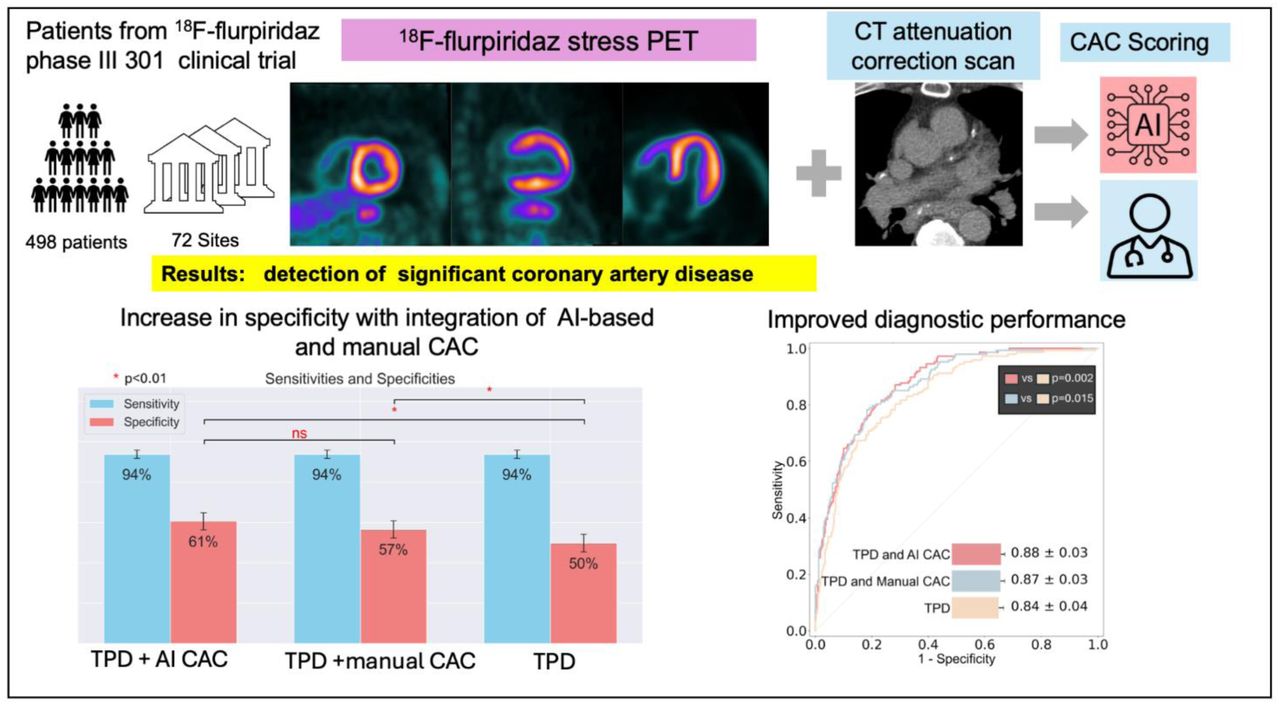
Graphical Abstract.
  • Download figure
  • Open in new tab
Graphical Abstract. Overview of the study design.

Competing Interest Statement

Dr. Miller reports research and consulting support from Pfizer. Mr. Kavanagh, Drs. Berman and Slomka participate in software royalties for QPS software at Cedars-Sinai Medical Center. Dr. Slomka has received research grant support from Siemens Medical Systems and consulting fees from Synektik. Dr. Berman has served as a consultant for GE Healthcare. Christopher Buckley is an employee for GE healthcare. The authors have no other relevant disclosures.

Funding Statement

This research was supported in part by grant R35HL161195 from the National Heart, Lung, and Blood Institute at the National Institutes of Health and R01EB034586 from the National Institute of Biomedical Imaging and Bioengineering of the National Institutes of Health. This work was also supported in part by the Dr. Miriam and Sheldon G. Adelson Medical Research Foundation and a grant from the American College of Cardiology in support of the Asher Kimchi Memorial Fellowship. The content is solely the responsibility of the authors and does not necessarily represent the official views of the National Institutes of Health.

Author Declarations

I confirm all relevant ethical guidelines have been followed, and any necessary IRB and/or ethics committee approvals have been obtained.

Yes

The details of the IRB/oversight body that provided approval or exemption for the research described are given below:

This is a posthoc analysis of a completed trial (NCT01347710) that previously received IRB approval from each study site. https://clinicaltrials.gov/study/NCT01347710. Each study site obtained approval from their respective Institutional Review Board or ethics committee, and the study protocol adhered to the principles of the Declaration of Helsinki. Informed consent was obtained from all participants in writing prior to the commencement of any study procedures. All data were de-identified.

I confirm that all necessary patient/participant consent has been obtained and the appropriate institutional forms have been archived, and that any patient/participant/sample identifiers included were not known to anyone (e.g., hospital staff, patients or participants themselves) outside the research group so cannot be used to identify individuals.

Yes

I understand that all clinical trials and any other prospective interventional studies must be registered with an ICMJE-approved registry, such as ClinicalTrials.gov. I confirm that any such study reported in the manuscript has been registered and the trial registration ID is provided (note: if posting a prospective study registered retrospectively, please provide a statement in the trial ID field explaining why the study was not registered in advance).

Yes

I have followed all appropriate research reporting guidelines, such as any relevant EQUATOR Network research reporting checklist(s) and other pertinent material, if applicable.

Yes

Data Availability

To the extent allowed by data sharing agreements and IRB protocols, the deidentified data and data analysis code from this manuscript will be shared upon written request.

  • Abbreviations

    PET
    Positron Emission Tomography
    MPI
    Myocardial Perfusion Imaging
    TPD
    Total Perfusion Deficit
    CTAC
    Coronary Tomography Attenuation Correction
    CAC
    Coronary Artery Calcium
    ICA
    Invasive Coronary Angiography
    AI
    Artificial Intelligence
    CAD
    coronary artery disease
  • Copyright 
    The copyright holder for this preprint is the author/funder, who has granted medRxiv a license to display the preprint in perpetuity. It is made available under a CC-BY-NC-ND 4.0 International license.
    Back to top
    PreviousNext
    Posted July 11, 2025.
    Download PDF

    Supplementary Material

    Data/Code
    Email

    Thank you for your interest in spreading the word about medRxiv.

    NOTE: Your email address is requested solely to identify you as the sender of this article.

    Enter multiple addresses on separate lines or separate them with commas.
    Incremental diagnostic value of AI-derived coronary artery calcium in 18F-flurpiridaz PET Myocardial Perfusion Imaging
    (Your Name) has forwarded a page to you from medRxiv
    (Your Name) thought you would like to see this page from the medRxiv website.
    CAPTCHA
    This question is for testing whether or not you are a human visitor and to prevent automated spam submissions.
    Share
    Incremental diagnostic value of AI-derived coronary artery calcium in 18F-flurpiridaz PET Myocardial Perfusion Imaging
    Orit Barrett, Aakash Shanbhag, Ryan Zaid, Robert J H Miller, Mark Lemley, Valerie Builoff, Joanna X. Liang, Paul B. Kavanagh, Christopher Buckley, Damini Dey, Daniel S. Berman, Piotr J Slomka
    medRxiv 2025.07.07.25330013; doi: https://doi.org/10.1101/2025.07.07.25330013
    Twitter logo Facebook logo LinkedIn logo Mendeley logo
    Citation Tools
    Incremental diagnostic value of AI-derived coronary artery calcium in 18F-flurpiridaz PET Myocardial Perfusion Imaging
    Orit Barrett, Aakash Shanbhag, Ryan Zaid, Robert J H Miller, Mark Lemley, Valerie Builoff, Joanna X. Liang, Paul B. Kavanagh, Christopher Buckley, Damini Dey, Daniel S. Berman, Piotr J Slomka
    medRxiv 2025.07.07.25330013; doi: https://doi.org/10.1101/2025.07.07.25330013

    Citation Manager Formats

    • BibTeX
    • Bookends
    • EasyBib
    • EndNote (tagged)
    • EndNote 8 (xml)
    • Medlars
    • Mendeley
    • Papers
    • RefWorks Tagged
    • Ref Manager
    • RIS
    • Zotero
    • Tweet Widget
    • Facebook Like
    • Google Plus One

    Subject Area

    • Radiology and Imaging
    Subject Areas
    All Articles
    • Addiction Medicine (576)
    • Allergy and Immunology (868)
    • Anesthesia (306)
    • Cardiovascular Medicine (4482)
    • Dentistry and Oral Medicine (449)
    • Dermatology (385)
    • Emergency Medicine (614)
    • Endocrinology (including Diabetes Mellitus and Metabolic Disease) (1528)
    • Epidemiology (15277)
    • Forensic Medicine (31)
    • Gastroenterology (1133)
    • Genetic and Genomic Medicine (6644)
    • Geriatric Medicine (671)
    • Health Economics (1006)
    • Health Informatics (4603)
    • Health Policy (1378)
    • Health Systems and Quality Improvement (1623)
    • Hematology (544)
    • HIV/AIDS (1276)
    • Infectious Diseases (except HIV/AIDS) (15960)
    • Intensive Care and Critical Care Medicine (1111)
    • Medical Education (626)
    • Medical Ethics (147)
    • Nephrology (674)
    • Neurology (6695)
    • Nursing (346)
    • Nutrition (1006)
    • Obstetrics and Gynecology (1153)
    • Occupational and Environmental Health (961)
    • Oncology (3369)
    • Ophthalmology (988)
    • Orthopedics (370)
    • Otolaryngology (421)
    • Pain Medicine (437)
    • Palliative Medicine (131)
    • Pathology (669)
    • Pediatrics (1704)
    • Pharmacology and Therapeutics (700)
    • Primary Care Research (717)
    • Psychiatry and Clinical Psychology (5494)
    • Public and Global Health (9285)
    • Radiology and Imaging (2223)
    • Rehabilitation Medicine and Physical Therapy (1375)
    • Respiratory Medicine (1201)
    • Rheumatology (598)
    • Sexual and Reproductive Health (721)
    • Sports Medicine (535)
    • Surgery (722)
    • Toxicology (100)
    • Transplantation (290)
    • Urology (267)